Lounge Lizard EP-5 Upgrade from Lounge Lizard EP-4
Upgrade from Lounge Lizard EP-4 (Must verify serial number on checkout)
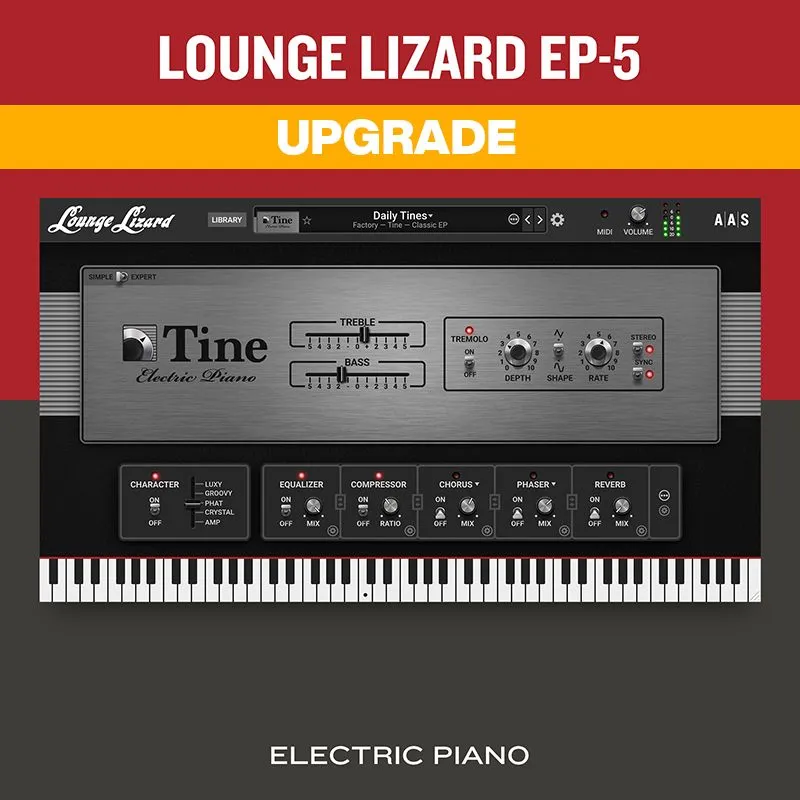
With a redesigned modeling engine, dual tine and reed synthesis, and three expressive sound packs, EP-5 offers deeper control, richer tone, and fresh creative possibilities.
With Lounge Lizard EP-5, that elusive electric piano sound becomes not just accessible—but endlessly playable and more expressive than ever. Powered by a completely redesigned physical modeling core and new dual-engine architecture, EP-5 delivers the pure, iconic tones of both tine- and reed-based instruments—with zero samples and limitless creative control.
Whether you’re chasing vintage warmth or reshaping the electric piano into bold new textures, Lounge Lizard EP-5 gives you the tools, flexibility, and playability to do it all.
NEW Features in Lounge Lizard EP-5
- Dual synthesis engines for reed and tine models
- Redesigned modeling core with even greater realism and response
- Dedicated GUIs for each engine
- New preset library with classic and modern sounds\
- Improved browser with search function and faster access
- Guitar amp model added to effects rack
- Microtuning support via Scala files
- Scalable GUI with intuitive layout for performance and editing
- Enhanced effect section with compressor, chorus, phaser, wah-wah, distortion, reverb, and more
New Dual Synthesis Architecture
EP-5 introduces two fully independent modeling engines—one for tine-based and one for reed-based electric pianos. Each engine is accessible via its own dedicated GUI, giving you immediate control over character, feel, and tone. Move between sweet and mellow or bright and biting without compromise.
Total Tone Control
Adjust the stiffness, impact, and noise of the hammer to shape your attack and playing dynamics across the keyboard range.
Fork
A sweet sound is produced when the hammer hits the fork. Control the tone and its envelope by selecting material and natural decay of the tone and tine bars forming the fork.
Pickup
Like in an electric guitar, a pickup near the fork captures its vibration. Adjust the pickup position and control distortion. Get a warm smooth tone or make your piano growl or bark.
Damper
Control how dampers are raised from or applied on the fork and make the attack and release of a note clean or noisy.
Tremolo
Adjust the tremolo to perfection. Use a triangle shape for a smooth effect or a soft square wave to obtain a chopped effect typical of suitcase pianos.
Presets and Effects
Lounge Lizard comes with an extensive preset library that is simply inspiring, giving you access to the classic electric piano sounds popularized by musical legends like Chick Corea, Herbie Hancock, Stevie Wonder, and George Duke. There is a choice of pure and true tones as well as a selection of processed ones courtesy of the high-end effects section.
The effects section includes the classic tremolo, chorus, wah, and phaser effects as well as EQ, delay and reverb. These effects are specially designed for the electric piano, making it very easy to create your own distinctive custom tones.
EP Character and Beyond
The original electric pianos provided timbre and volume adjustments by letting you position the tines in relation to the pickups. These adjustments were at the heart of the electric piano's character as they controlled the harmonic content, attack, and decay of the sound, offering unique tone to each player. But there was a price for this flexibility. Several painstaking hours with a screwdriver and incredible patience was needed to change the sound of an electric piano.
Suffer no more! With Lounge Lizard, the preset library provides a selection of thoroughly chosen Tine/Pickup configurations. You also have the ability to make those adjustments in real time via two simple controls: Distance and Symmetry.
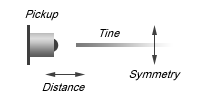
It doesn't end there. Because controls are provided for the various electromechanical components, Lounge Lizard can be pushed far beyond hardware equivalents, opening up a completely new realm of sonic possibilities!
What's more, since the interaction between the tine and pickup is quite unique, its effect can't be obtained with the filtering provided by samplers. This limits sampled solutions to one or two fixed configurations and brings physical modeling to the forefront of the electric piano recreation.
Modeling an Electric Piano: How it works
The electric piano was invented by Harold Rhodes (1910-2000) during the forties when he was in the army. The first instruments he built were made of aircraft pieces and were intended to entertain army servicemen. It became a very popular instrument in jazz and rock, and has enjoyed a resurgence in recent years through it's extensive use by the world's top hip hop, R&B, and house producers.
The mechanism of the electric piano is, in fact, quite simple. A note played on the keyboard activates a hammer that hits a fork. The sound of that fork is then amplified by a magnetic coil pickup and sent to the output, very much like an electric guitar.
Requires Lounge Lizard EP-4 (verify serial number on checkout)