Studio FX Piano
The Well-Prepared Piano
Tradition meets innovation: Painstakingly captured over the course of more than four months in the pristine, controlled environment of Stage B at Vienna Synchron Stage, this unique collection redefines what a piano can be – and sound like. Expanding significantly on the “prepared piano” concept popularized by avant-garde composer John Cage in the 1940s, The Vienna team transformed their Yamaha CFX into a groundbreaking instrument of sonic exploration.
NEW Studio FX Piano
Product features:
- Prepared & FX piano sounds
- Unconventional sound design, transforming piano tones into unique percussive and resonant textures
- Versatile performance styles like glissandos, string scrapes, mallet strikes, EBow, etc.
- Special FX Presets in the categories percussive, pads, spacious, delays, evolving
- Additional FX mixer presets
- Production-ready sound, straight out of the box
- Optional convolution reverb, derived from Vienna MIR Pro 3D
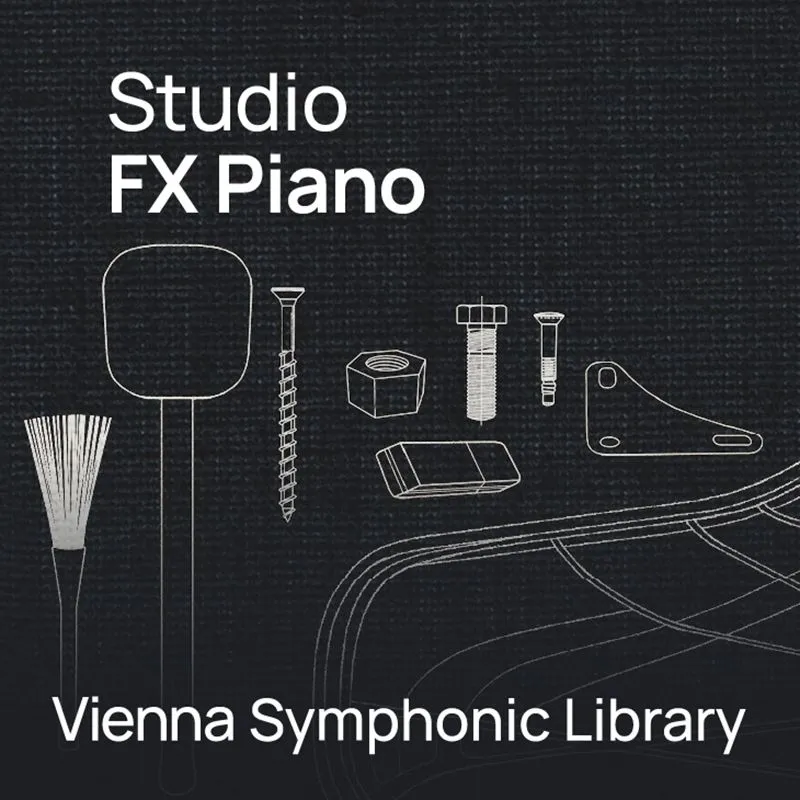
By manipulating its strings with objects such as screws, bolts, rubber, felt wedges, chains, and paper, or utilizing an EBow for infinite sustain, it now produces a myriad of adventurous tones far removed from its classical origins. The controlled ambience allows you to shape your custom FX sounds any way you want, while the optional convolution reverb derived from Vienna MIR Pro 3D adds space and even more creative versatility. A wide array of dedicated FX patches and mixer presets takes this sonic adventure to entirely new dimensions, inviting you to push the boundaries of sound design.
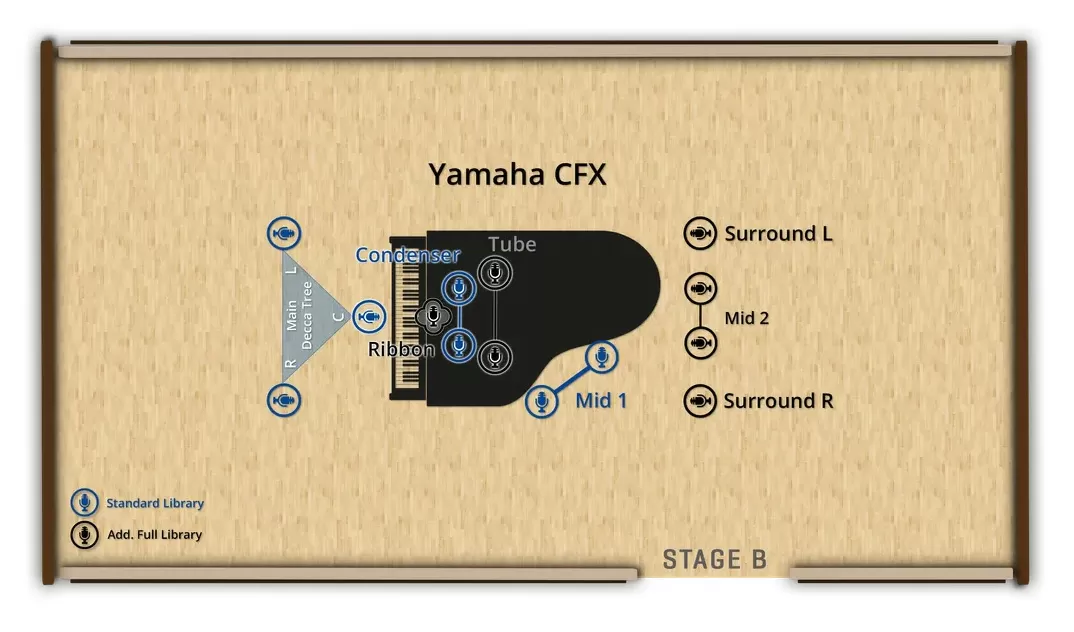
The Standard Library versions of the VSL studio pianos feature an essential set of close mics plus the classic sound of a Decca tree stereo array. The Full Library versions add more close mic options and include all available room microphones for a wide variety of stereo and surround possibilities.
Prepper’s Delight
When it comes to high-performance music, preparation is key – and in this collection, that concept takes on a whole new, literal meaning. Synchron Stage Vienna’s very own piano tuner and specialist Max Kubizek conducted extensive research to unlock the unique sound possibilities he and Synchron Stage chief conductor Gottfried Rabl envisioned for this exceptional product, which is vastly more expansive and versatile than the previously released prepared piano in Vienna’s Studio Special Keyboards collection. The results give you incredible freedom for experimentation.
During the recording sessions, no boundaries were set: the bass strings were slapped by hand or plucked with a guitar pick, the piano body was struck with a mallet, metal screws and bolts created sharp metallic overtones, while rubber and felt dampened the vibrating strings to produce muted, drum-like beats. These unconventional techniques and non-traditional approaches generated complex and unexpected sound layers, ranging from mystical drones to sharp, percussive hits that are as inspiring as they are unique.
Pure Experimentation
The relatively dry Stage B is perfect for capturing prepared and FX piano sounds that feel as direct and pure as if you were sitting right in front of the instrument while the sound-altering materials are applied. With both algorithmic and convolution reverb options, this prepared piano adapts seamlessly to any musical setting and can be placed in any acoustic environment you desire – ranging from tight, intimate studio spaces to richly reverberant surroundings. Whether you’re crafting cinematic soundscapes or experimental avant-garde compositions, this instrument equips you to explore world of previously unheard piano tones.
Preparations includes a plethora of items such as screws, felt wedges, erasers, chains, aluminum foil, sheet metal, glass plate, leather, brushes, various mallets, EBow, fishing line, different picks for strumming, fingernails, and even a bicycle inner tube! Additionally, the Standard Library and Full Library of Studio FX Piano both include the same articulations. The difference lies in the number of provided microphone positions
Preparations:
- Screws inserted between two of the three strings at octave position
- Screws inserted between two of the three strings at fifth position
- Screws with loose nuts inserted between two of the three strings at octave position
- Felt wedges normally used for tuning inserted between strings while playing
- Eraser parts cut to size are inserted at half string length, resulting in a flageolet sound
- Chains of about 30 cm length with 5–7 mm link size put on the strings
- Paper strips threaded between the strings behind the damper to inhibit their free movement
- Aluminum foil lying on the strings is caused to vibrate when they are struck
- A small piece of sheet metal centered on the string and bouncing along
- A glass plate put on the bass strings makes enormous noise
- A water glass pressed onto the strings and moved after the keystroke, similar to a guitar bottleneck
- A hard glockenspiel mallet was used to play the strings from above for a dulcimer-like sound
- A rubber mallet was used to play the strings with screws inserted between the strings
- Timpani wool mallets were used to perform rolls on the strings
- Single strings were plucked with a Wegen Gipsy guitar pick
- Strumming all three strings of a note with the Gipsy guitar pick, with dampers on the strings
- EBow string stimulation for pad-like sounds
- EBow with a nut put on the oscillating strings
- A fishing line was rubbed with rosin and threaded between the strings several times so that they could be bowed like a cello
- Fishing line crescendos
- Fast and slow up and down glissandos played with a leather pick between the trusses
- Rasping bass strings with the fingernail
- Glissandos played with percussion brushes in several positions
- Dragging the inner tube of a bike across the strings to achieve something like whale song
- Hits with the open hand on the bass strings in several positions
- A gong mallet was used to play on the trusses from the side and from above. The hits gain a lot of body and reverb by pressing the pedal.
- The piano body is hit with a timpani mallet in several positions
- The Standard Library and the upgrade to the Full Library (sometimes referred to as the Extended Library) are separate downloads.
Hard Drive Space Requirements
- Free storage space for the Standard Library: 92 GB
- Free storage space for the Full Library: 196 GB