
Making successful rap, hip-hop and pop music these days is often the work of a number of people. Beyond the main artist performing, there are people creating beats, writing the music bed, developing top line vocals, performing and engineering/mixing/mastering. When some producers meet and find commonality it can lead to even greater results, as the team gets to know each other and develop a symbiotic working relationship. Such is the case with Willy Yanez and Eliot Dubock (Beat Butcha).
On their own, each artist has impressive credentials: Yanez has collaborated/worked with Eminem, Future, Daddy Yankee, and bLAck pARty. Beat Butcha has produced for SZA, Big Boi of Outkast, Mac Miller, The Carters, Schoolboy Q, Brent Faiyaz, Jordan Ward, Banks, Tyler, the Creator, and various members of the New York-based Griselda Records hip-hop collective. After meeting through a common friend, the two producers found a creative kinship working together, and for the last three years have been racking up hit after hit, including “Mona Lisa” off the soundtrack for Spider-Man: Across the Spider-Verse (with Dominic Fike), “Exit 9” with Killer Mike, “A Soldier’s Story?” By Grip, and "High Roller” by Fana Hues.
Most recently, their collaborative efforts culminated in contributions to Grammy-winning albums: 'Michael,' featuring their work with Killer Mike, for Rap Album of the Year, while Beat Butcha's involvement in SZA's 'SOS' garnered a win for Progressive R&B Album of the Year.
We recently sat down with the pair and they shared their story and approach to collaboration.
Differences Enhance The Process
Looking at their backgrounds you find little in common with their early years. Willy came to music as a player, picking up guitar at an early age. His family had moved from Mexico to Chicago, and a neighbor friend’s dad, who played rock guitar first inspired him. But the jazz scene that thrived in Chicago also has some influence as he grew up, and he soon found himself playing guitar and keys in bands, and doing a lot of theatre pit-orchestra work. He recalls, “By the time I was sixteen, I played professionally in the city, getting that firsthand experience even before I went to college. I ended up touring with a number of shows and then playing in bands when I was home. When I was in those bands, I would help write the songs and we would produce our own albums. I would also do session work, and once I realized I didn't want to play for touring artists, then you're getting thrown more into the studios. And that's where I bridged the gap, learning music software, DAWs, plug-ins and such. So I was able to take years and learn to incorporate that stuff into what I did.”
So I was able to take years and learn to incorporate that stuff into what I did.
Growing up in the UK, Beat Butcha started off with a wide range of music being played in his household, but no instrument players within his family and friends. He became a collector of CDs and tapes, and as he recounts, “I became super obsessed with it. And once I found hip-hop I just got really hyper-focused on it. In the early days, I was into all sorts of stuff: I grew up in the 80s and 90s, so whatever was around at the time, I was into. I dabbled a bit with bands while at school; played a little drums, played some guitar, but wasn't really great at guitar. I was probably better at drums, which plays into the drum kit libraries that I do. And by about sixteen, I started to get into DJing and making beats.” He made a name for himself on the UK scene, and after about fifteen years set his sights on the US and came to Los Angeles to further develop his career.
Once I found hip-hop I just got really hyper-focused on it.
The partners feel that their differences helps them to cover more ground and see possibilities in their production work. Butcha states, “One of the cool things about our relationship is we both come from different backgrounds, so we've been able to learn a lot from each other in terms of influences, feed off each other's energy, and just get inspired by each other.” Yanez picks up, “I think that's a great thing about us working together, that we're both able to wear so many different hats. If we’re writing with an artist, I might record the vocals while he’ll be playing bass. Or he’ll add new ideas so we're both able to experiment — I think collaboration is awesome, but it’s not always easy to do…” “It’s hard to find people that are on the same wavelength,” Butcha interjects, “and I feel that.” “A thousand percent,” Willy adds.
I think collaboration is awesome, but it’s not always easy to do…It’s hard to find people that are on the same wavelength.
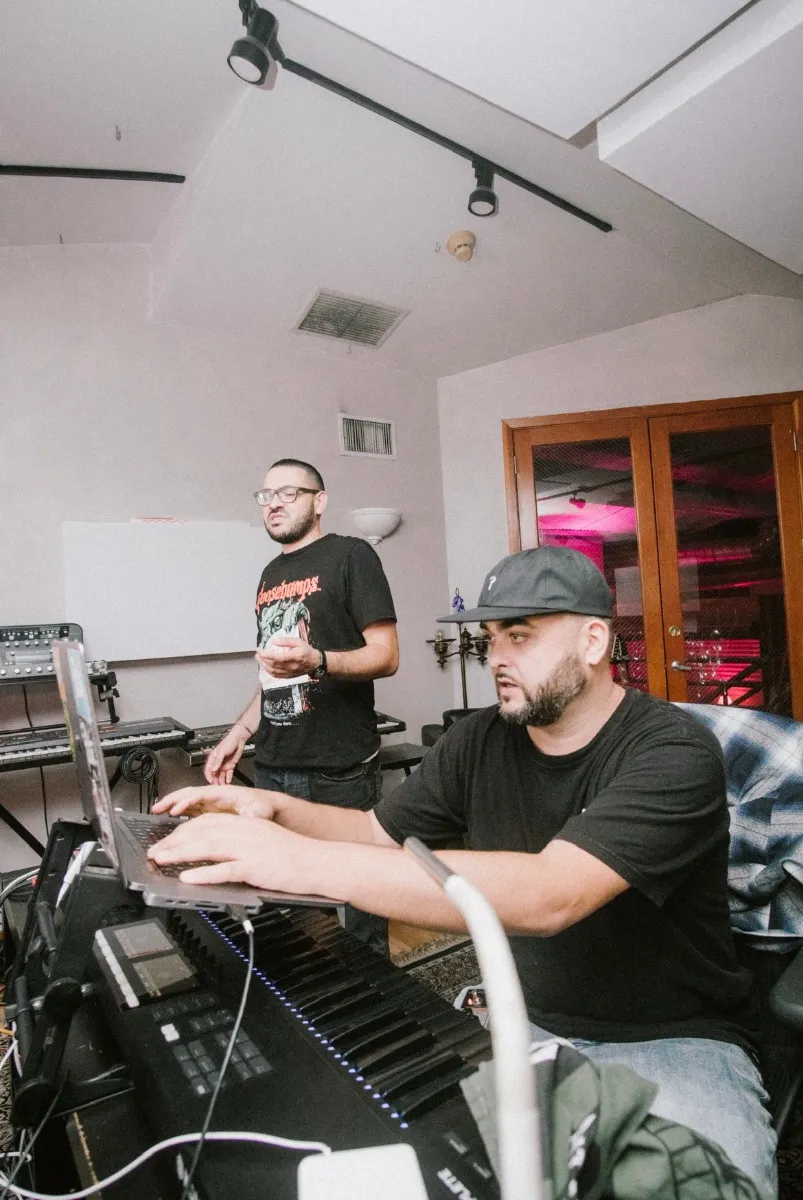
Butcha continues, “Most of the time, when we get together, we're just making stocks or ideas for when we get in a session with an artist or something. The cool thing is we just try and make whatever we like, and then figure out where it's going to go afterwards.”
Bringing New Ideas
A common thread in our discussion was how the pair likes to experiment, and try ideas outside of the norm in the music they produce. Butcha explains, “Once people get to know us, they realize that we might take steps that other producers probably wouldn't take. I think people in our circle come to us for that as well. You know who you can give what to a lot of the times as well. Sometimes there's an element of reverse psychology that you're using to get people to try things, you know what I mean? But we've been fortunate to be working with a lot of people that are trying to do different things, like our recent project with Fana Hues, and my work with Jordan Ward. He is definitely willing to try different tempos and different bounces, even different chords.”
Once people get to know us, they realize that we might take steps that other producers probably wouldn't take.
“With a lot of artists, they might start out saying that they don't want to write certain things. But we always seem to pull off a lot of stuff,” offers Willy. “Lately, we've been doing a lot on the spot with artists, which is cool.”
Discussing how their process develops organically, Butcha relates, “As it's getting written, we’ll try to adapt to whatever is happening. Often, once things are starting to be recorded, I'll start to move parts around, think about changing certain things to complement whatever the vocals are doing. Sometimes it might even be taking things out. Making little changes just to help the tracks flow better and give them moments.”
Willy adds, “Yeah, and it's cool, because a lot of times I’ll write with an writer/artist I get set up with, and I'll start by pulling up beats or ideas we have. We’ll come up with some ideas, and then we’ll take it back here, and work on it even more.” “I’m a massive fan of post-production,” interjects Butcha. “I think you can really breathe a lot of extra life into songs.” “Yeah, I’m the same,” Willy relates, “and the writing influences the post-production.”
Lately, we've been doing a lot of stuff on the spot with artists, which is cool.
Tools Of The Trade
Both producers have their favorite gear, both hardware and software. Butcha goes first: “I'm a massive fan of old gear; I still have a bit of a digger mentality… I like finding out what they used on some of my favorite old songs and trying to source those bits of gear. We're both big fans of taking retro elements and then making modern music. I've got a Rhodes Chroma, and I've got this Vox Continental Baroque and a bunch of other stuff. I also really like the Moogerfooger filter pedal — I throw that on everything.”
We're both big fans of taking retro elements and then making modern music.
“I've still got a little Marshall Valvestate amp from when I was about twelve, which I use for the reverb. It's got a crappy spring reverb on it that sounds sick!”
Willy recounts, “I’ve got a favorite guitar, it's a 1970 Martin 00-18 that just sits perfectly in a mix. I used it on “Mona Lisa”, the tune we did with Dominick Fike. For my synths it’s definitely a Prophet-10 and a Juno-60 right now. I look at people that have so much gear, and I realized it's like a journey for them. So now I'm trying to get to that point where you remember each one. It's like, ‘oh, I bought that with my last $1,000, or when I had this song come out, I got this.’ So everything has a story.”
“I think we're both a mixture of in the box and out of the box as well,” Butcha states. “I don't think you need all of this gear to make good stuff. It's more about your feeling — you can make music on anything. But for me, all of this stuff is about inspiration; it’s about pulling up something that might spark an idea.”
But for me, all of this stuff is about inspiration; it’s about pulling up something that might spark an idea.
Both producers are big fans of Spectrasonics virtual instruments. Willy often goes to Omnisphere, even though he owns some classic analog gear. “If I think I’m going to want to make changes later on in the production process, it’s much more convenient to use software. If we're working somewhere else and we don't have access to our synths it's cool to know that the sound quality is going to be really high and we can trust it. I’ve recently been using some of the Fame pack libraries. But I'll modify them or run it through stuff. Or it just becomes a placeholder for when I need to make a new sound. I think presets are cool, to give inspiration, or as the starting point for something. And I love the Sound Match selection feature where you can take a sound, and then it tells you about some similar sounds.”
I think presets are cool to give inspiration, or as the starting point for something.

Butcha weighs in: “Omnisphere is sick, it’s pretty versatile. Definitely used it on a bunch of stuff. But for me it’s Keyscape, because there's so many patches in there that I love: I've used the upright on so many things, a couple of the auto wah clav sounds. And I have a patch that I made for the student Butterfly piano with a short tape delay that I use all the time… it's such a versatile plugin, probably the most realistic sounding keyboard plugin that's out there.”
“I will say that something I really like about Omnisphere is the layers,” enthuses Butcha. “Sometimes I'll mute the other layers and just keep one layer, messing around with that. Say you've got a burning piano or something like that. I'll just take the burning sound and tuck it somewhere low in the mix. I’ve used a couple of gospel samples: there are a couple of patches with just the congregation talking in the background. You just tuck those low in the mix somewhere. I love that kind of stuff.”
(Keyscape is) probably the most realistic-sounding keyboard plugin that's out there.
They used these tools in their latest collaboration, “High Roller” with Fana Hues. Butcha points out a Keyscape patch he used which is an adaptation of one of the Wurlie sounds. He explained that “I put this short arpeggiator that wasn’t clocked to the BPM and then another really fast one, so it created this kind of sprinkling effect that came out really nice.” It can be heard clearly in the intro to the tune.
Both artists point out that they have a lot of upcoming releases, but they can’t talk about them until the main artists are ready to release them. But you can be sure that you’ll be hearing a lot more from this production team in the upcoming years.
For more info on Beat Butcha, visit here.
For more info on Willy Yanez, visit here.