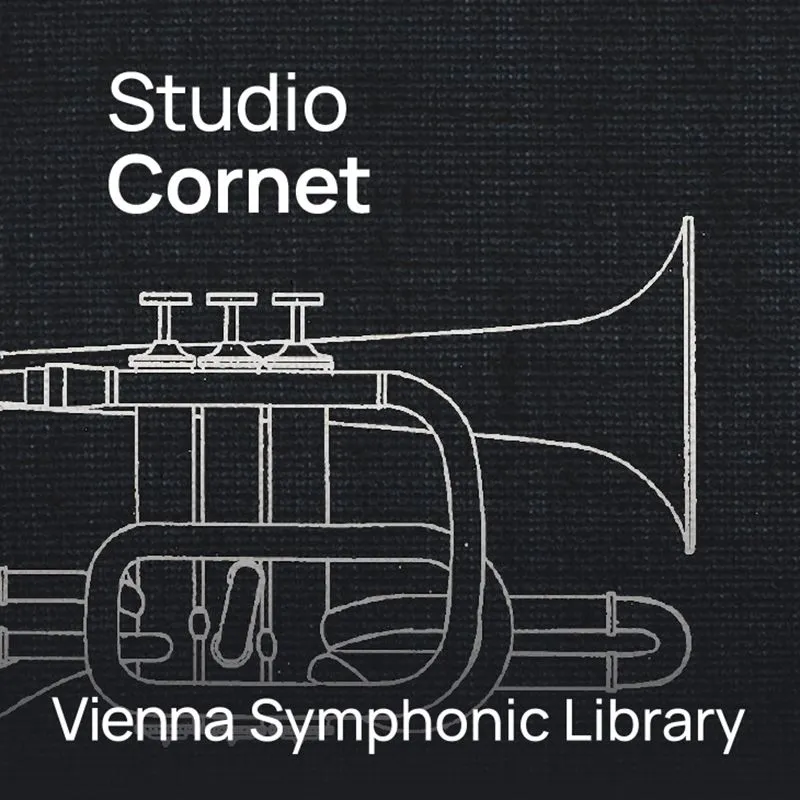
Studio Cornet
Known for its warm, round tone, the cornet is a staple of brass bands and concert works. Its flexibility makes it equally suited for solos, ensemble parts, and jazz improvisation. With a mellower sound than the trumpet, it excels in lyrical solos brimming with rich harmonics. Whether you’re channeling your inner Bix Beiderbecke or exploring new creative possibilities for the cornet in your projects, the pure, dry recordings from Vienna’s Silent Stage are sure to inspire.
Studio Cornet
The Warmth of Brass
- Cornet in Bb with various articulations
- Short and long notes, legato, dynamics, trills, repetitions, flutter tongue
- Recorded at the Silent Stage
- Mixer presets for authentic placement at Vienna Synchron Stage
- Optional Vienna MIR Pro 3D-derived convolution reverb
- Switch off internal reverb for placement in any virtual acoustic environment
From Military to Modern
Due to its wide conical bore, the cornet (French: cornet à pistons) is classified as a horn instrument, even though it looks more like a trumpet. The first cornet was built around 1828 by Louis Antoine Halary in France and initially served a historical role in military and marching bands. Later, the instrument found its way into symphony orchestras of the Romantic period, sometimes replacing the trumpet in certain compositions.
Blend or Stand Out
Compared to the trumpet, the cornet has a softer, mellower sound due to its construction, though it has a slightly more limited dynamic range. This quality allows it to blend beautifully within brass ensembles. Its unique timbre also makes it an intriguing choice for creative solo parts and improvisation.
Versatile and Expressive
The library features a full set of expressive and dynamic articulations, offering various short and long notes, legatos (including fast legatos), crescendos and diminuendos, sfz, sffz, pfp, flutter tongue, and half and whole tone trills. Recording the samples relatively dry at the Silent Stage makes it possible to place them on your virtual stage and in the stereo field wherever you like, but also enables you to integrate the instrument with the Synchron Series by using the internal convolution reverb recreating Vienna’s own scoring stage, Vienna Synchron Stage.
| ARTICULATION GROUP | ARTICULATIONS |
| Short notes |
Staccato |
| Long notes |
Sustained without, with normal and progressive vibrato |
| Performance legato |
Legato |
| Dynamics |
Sforzato, sforzatissimo, fortepiano |
| Fluttertongue |
Flutter tonguing normal and crescendo |
| Performance repetitions |
Legato |
| Fast Repetition |
Static, normal and cut release, 120–180 BPM |
| Upbeats |
1–3 upbeats, 80–140/160/180/200 BPM |
Hard Drive Space Requirements
- 2 GB (download size = installed size due to lossless data compression)