
Tom Scott, the iconic saxophonist, composer, and arranger, has etched an unforgettable legacy into our collective musical consciousness.
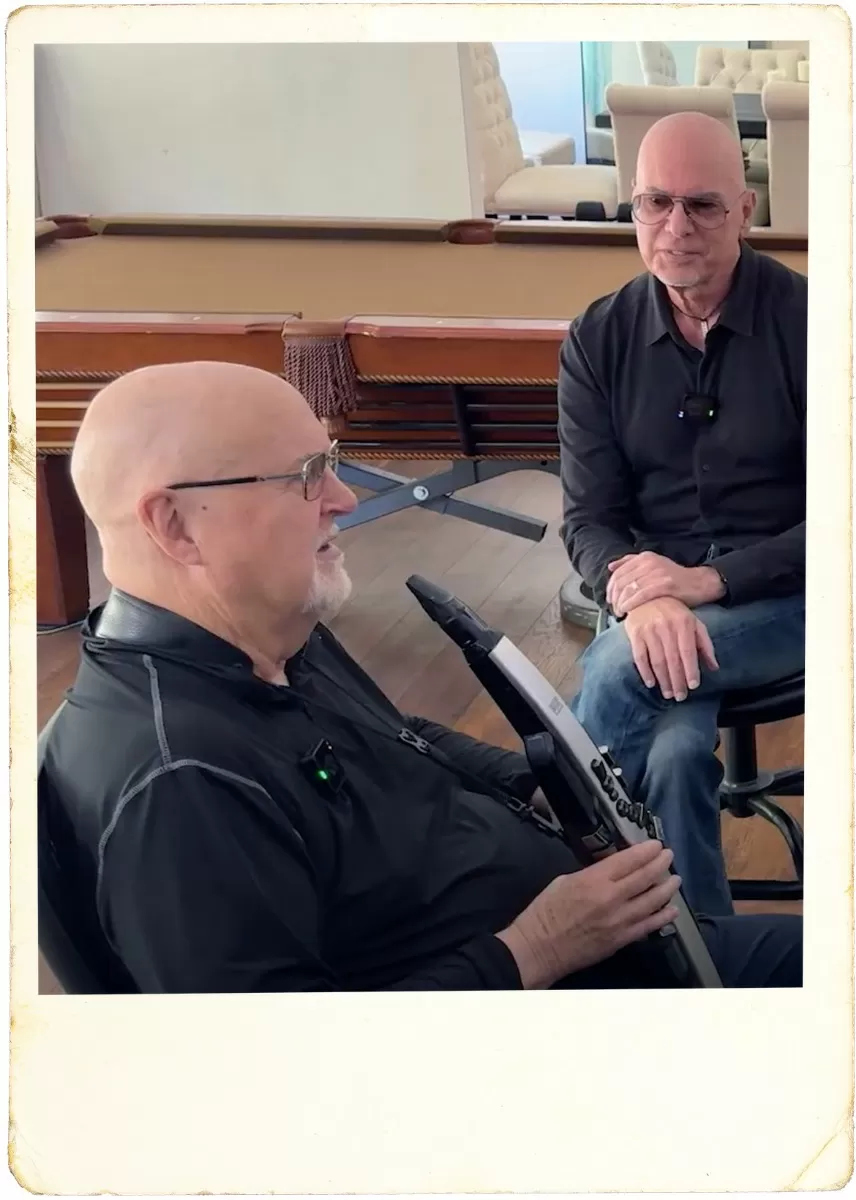
Tom Scott and Jon Gilutin together for the interview.
With three Grammy Awards to his name and a career that spans over five decades and countless famous recordings, Tom’s work has touched nearly every corner of the industry, from jazz and pop to television and film scores. He’s best known for his work with artists like Joni Mitchell, George Harrison, and Steely Dan, as well as his iconic solo on the theme song for Starsky & Hutch, among many memorable contributions.
Joining him in our discussion today is Jon Gilutin, a Grammy-winning keyboardist, composer, and producer. Jon has worked with the likes of Linda Ronstadt, James Taylor, and Barbra Streisand. His work as a producer and arranger has earned him a reputation for blending technical precision with soulful expression, making him a sought-after collaborator in both the studio and on stage. He also has an upcoming single featuring Tom Scott, set to be officially released in October 2024.
At the heart of their conversation is SWAM, a suite of modeled instruments by Audio Modeling. Unlike traditional sample-based instruments, SWAM instruments are crafted to respond to the musician’s touch with unprecedented realism and expression.
The discussion kicks off after Tom indulges in a bit of virtuosic play with the SWAM Trumpet, using his wind controller.
A Huge Step Forward
Jon Gilutin:
Oh, yeah, well, here we are with Tom Scott. Thank you for inviting us into your space.
Tom Scott:
My pleasure.
Jon:
That’s fantastic. So you’re now a SWAM user?
Tom:
I am, and it’s been, what, a couple of months now.
Jon:
And how has it been?
Tom:
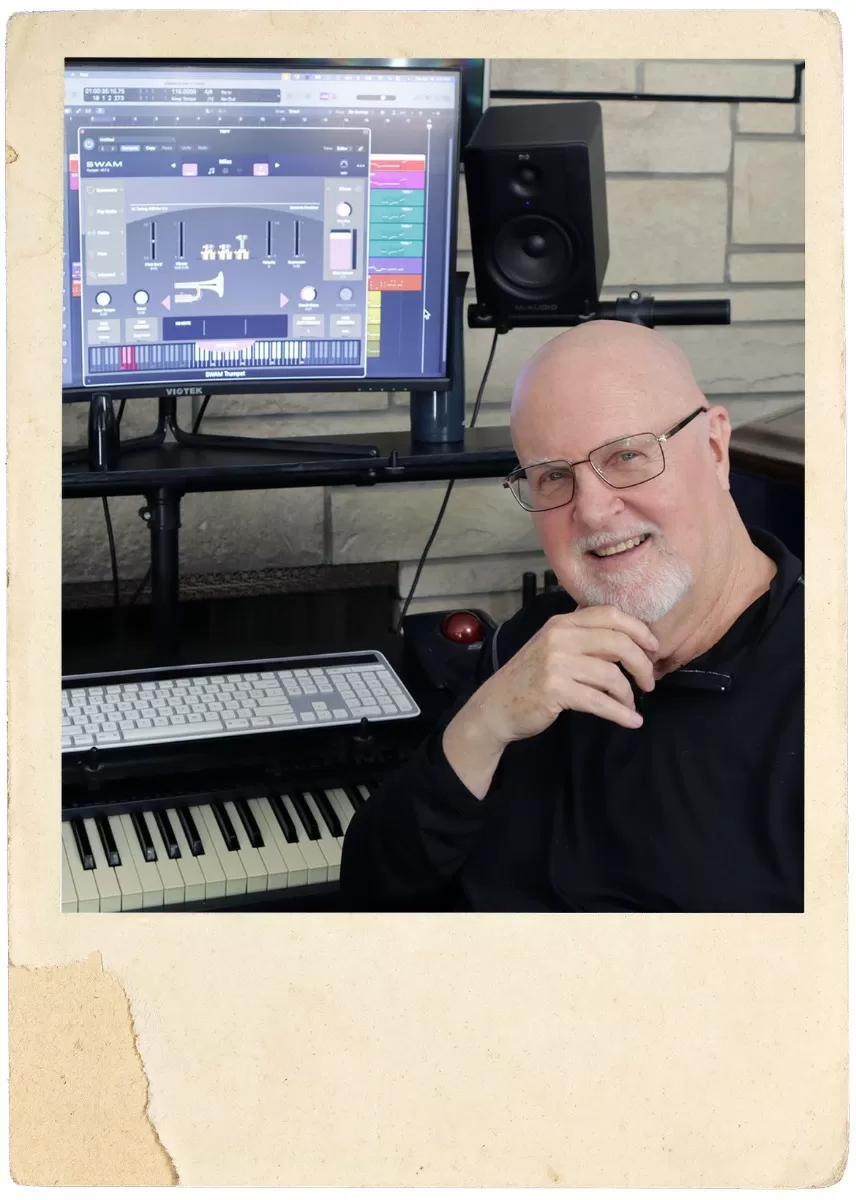
I’ve never had so many realistic-sounding instruments. Audio Modeling is a huge step forward. And what’s especially great about SWAM instruments is that I’m able to play them through my wind controller. I’m currently using the Roland Aerophone Pro, so all the parameters such as volume, vibrato, etc. are simultaneously recorded as I'm playing in real time. I don’t have to endlessly tweak the instruments afterwards to get them just right.
Audio Modeling is a huge step forward... all the parameters such as volume, vibrato, etc. are simultaneously recorded as I'm playing in real time. I don’t have to endlessly tweak the instruments afterwards to get them just right.
Exploring Workflow Changes
Jon:
So in your process, in your workflow, when you’re inputting all this information with the Audio Modeling instruments, are you always using the breath controller?
Tom:
When I’m using SWAM, yes, I found that to be the easiest way to most directly do strings, horns, woodwinds—everything. Even these little strings here, I just did them real fast. But the beauty of it is that I was able to do the dynamics I wanted right on the spot, without having to worry about, “Let me go to that bar.”
Jon:
That’s so cool. It’s been the same for me, using a breath controller. For me, not being a woodwind player or a brass player or even a string player, but mostly with the woodwinds and brass, I like using the breath controller because it keeps me honest.
Tom:
What do you mean?
Jon:
Well, I can only play a note as long as I can breathe. You’ve spent your whole life doing that, right? You’re used to it.
Tom:
Yeah. And how many arrangers do I know who thought that you never had to take a breath? You look at a part, and it was a part that they had you, and it’s just all—there’s not a rest in it, because they don’t think. And a lot of them were brass players, like trombone players. So some of the best arrangers of our time, yeah, trombone players. But they never thought of that.
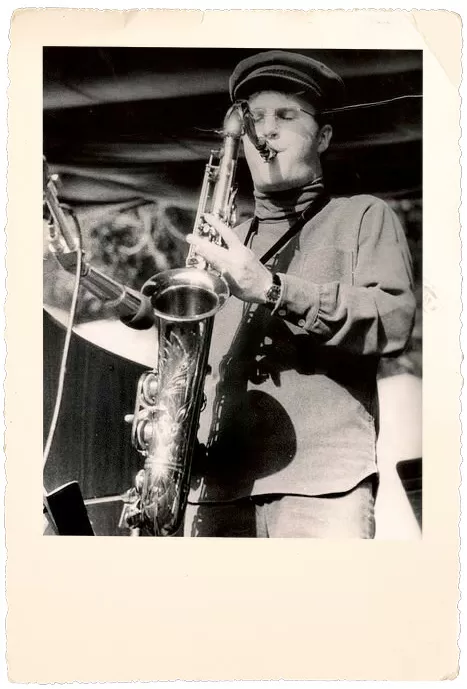
Tom at the Pilgrimage Theatre in Hollywood, CA, 1967.
The Old School Meets New Tools
Tom reflects on his roots, where composing meant painstakingly writing out each note by hand, a process that was both a rigorous discipline and a creative challenge. Today, his approach has evolved significantly, thanks to digital tools like SWAM.
Jon:
You come from the place where everybody used pencil and paper and wrote everything out on a score. How is your workflow different now?
Tom:
Well, it’s a whole lot different. I first started writing background music for television in the late 60's. I had to quickly develop my skills—composing and arranging for an orchestra using score paper with as many as 25 staves. It was hard work, but a tremendous education. "Dan August" (starring a then-unknown actor Burt Reynolds) was one of my first assignments. Composer/pianist Dave Grusin had recommended me. I was 21, I think. Most of the subsequent shows I scored were also cop shows: Streets of San Francisco, Cannon, Baretta, Starsky & Hutch. I used to write what I referred to as a “Law and Order Funk.” I was pretty good at that—some dramatic chords, but with a groove.
A Legacy of Influence
The conversation turns to Tom’s father, Nathan Scott, a prominent figure in the television music scene of the mid-20th century. Nathan’s legacy not only influenced Tom’s career but also left its own mark on the industry.
Jon:
Well, I found out that you were exposed to that kind of work from a really young age. Your father was one of the busiest composers in TV music in LA.
Tom:
That’s right. My father, Nathan Scott, started work at NBC in the parking lot in the early 40's. He already had a music degree from (UC) Berkeley, and knew that was what he wanted to do. He had a friend who worked at NBC Radio on Sunset and Vine in Hollywood parking cars. That was his first job in 'show business'! He soon graduated to what they called 'page boy' in those days, which is now known as 'tour guide'. All the while he was "living on cornflakes for months and writing arrangements during off-hours—hoping they would eventually be played by the NBC Staff Orchestra.” They did get played—and as a result, within two years, he became a music director at NBC—quite a sizable promotion! Following that, he worked as a staff composer/arranger at Republic Pictures. He wrote music mostly for westerns, including the entire score for a John Wayne movie called “Wake of the Red Witch."
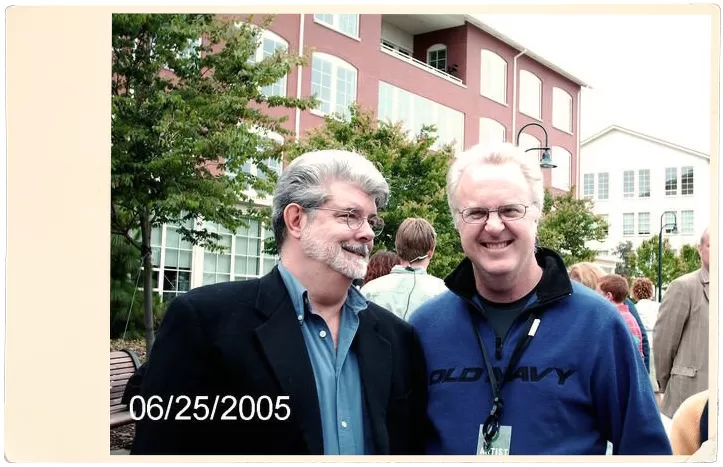
Tom Scott with George Lucas
Here's a quick story about my father, who passed in 2008. I was at a recording session in Hollywood with big orchestra. John Williams came in as a guest conductor do a medley of famous instrumental movie themes, which he’s done with orchestras all over the world. I was aware that John had known my dad, but that's really all I knew. I’m sitting at the end of a long row of woodwinds. He walks in and spots me. He walks over to me, kneels, and says, “Tom, I don’t know whether your father remembered me or not.” How humble is that? I replied, “John, I'm sure he remembered you.” He said, “The reason I say this is because when I was a studio pianist in the 1950's....” I mean, this is John Williams, one of the greatest film composers of all time! He continued, “and considering whether I wanted to try my hand at composing for films and television, one of my first assignments was one in which your father was my supervisor. And I wanted you to let you know—one of the main reasons that I decided to pursue it was because your father was so kind and encouraging to me.”
Every note has a purpose. No fluff anywhere, ever.
Tom:
He was a real perfectionist, and everybody loved my dad. If you took a note out of any piece of music he wrote, it wouldn't be right. Every note has a purpose. No fluff anywhere, ever.
Jon:
What would he think about the way that we do our work now?
Tom:
Even towards the end of his life, he tried. He got a Mac and and I went over one day to help on the biggest thing he was doing. He kept creating untitled folders, empty untitled folders. It’s a whole different way of thinking about things.
If you're depending on a computer program to tell you what the best choice is, well, you're severely limiting yourself.
I wish that more musicians who only know the world of computer-generated music would get some experience with a live band. It would teach them a world of knowledge about the individual instruments, what they do best, and how to write for them effectively—as you're using your SWAM instruments. If you're depending on a computer program to tell you what the best choice is, well, you're severely limiting yourself.
The Present and Future with SWAM
Tom’s enthusiasm for SWAM is undeniable. With Jon, he discusses how these instruments have reinvigorated his creative process, allowing him to explore new musical possibilities with ease and authenticity.
Tom:
It’s been transformative. You know, back in the day, we used to have to endlessly tweak samples to get the right sound and the right expression. Now, with SWAM, I can play these instruments just like I would play any real instrument, with all the nuances and expression I want, and it’s captured perfectly in the recording. It’s freed up my creative process significantly.
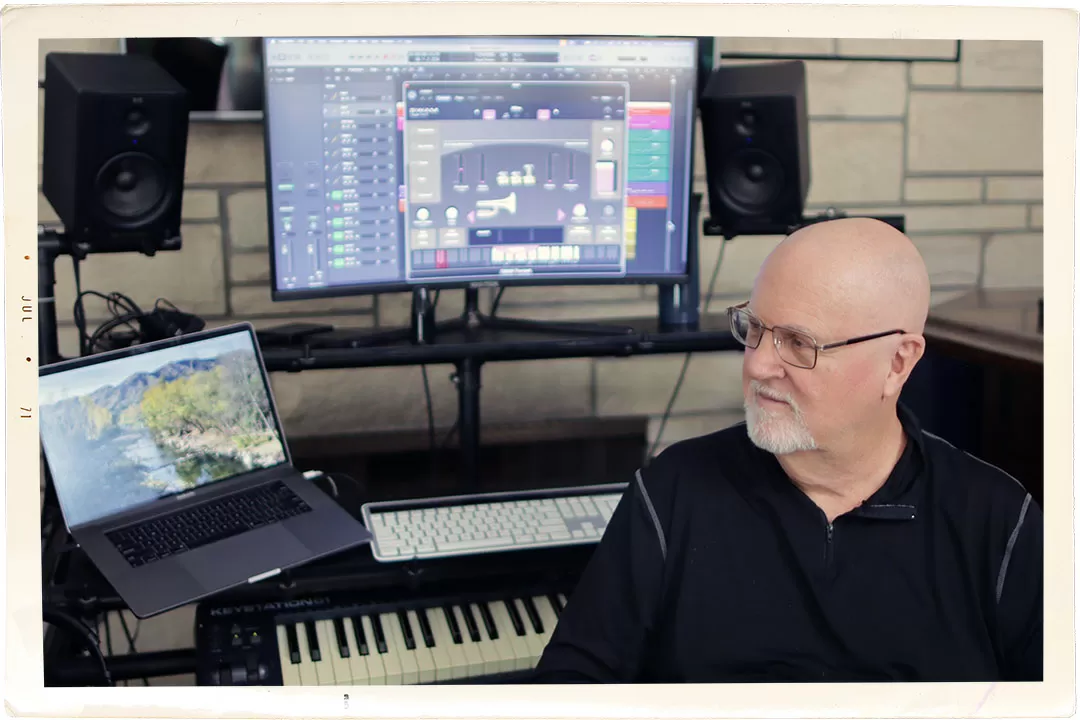
Jon:
That’s amazing, because up until now, someone doing what you do wouldn’t feel comfortable enough with models or samples to let them go out without enhancing them in some way with real instruments.
Tom:
Exactly. If it was my record, yes, I might layer it with a real tenor sax, for example. But if it’s a cue? Not necessarily at all. I’m happy enough with the SWAM instruments as they are to use them in professional settings. And I’m really excited to keep experimenting and seeing how close I can get these to sounding like the real thing. They’re pretty damn good right now, but I know there’s always room for growth and experimentation.
Jon:
It sounds like these instruments have really opened up some new creative avenues for you. Have they inspired you to start thinking about new projects?
With these instruments, I feel like I can create something at home that’s nearly complete and then maybe bring in some special guests to add a live quality. But the core of it could be entirely SWAM.
Tom:
Definitely. I’ve been considering putting out another album, which I haven’t done in many years. With these instruments, I feel like I can create something at home that’s nearly complete and then maybe bring in some special guests to add a live quality. But the core of it could be entirely SWAM, and that’s really exciting for me.
Jon:
That’s incredible. It sounds like these tools are really pushing the boundaries of what’s possible, even for someone with your extensive experience.
Tom:
That’s what keeps me going. I’ve always been about finding new ways to express myself and to connect with listeners. SWAM gives me another tool in the toolkit, and I’m really excited to see where it takes me—and where it takes the next generation of musicians.
Jon:
Thank you so much, Tom, for sharing your thoughts and experiences with us today. It’s been a pleasure.
Tom:
Thank you, Jon. It’s been great talking with you.
For more info on Tom Scott, visit here.
Additional photos provided by tomscottmusic.com/scrapbook.